CARDBOARDFILE
baseball / 1989 Upper Deck / 1
1989 Upper Deck Ken Griffey Jr. #1
Card number one, given to a nineteen-year-old who had never batted in the majors.
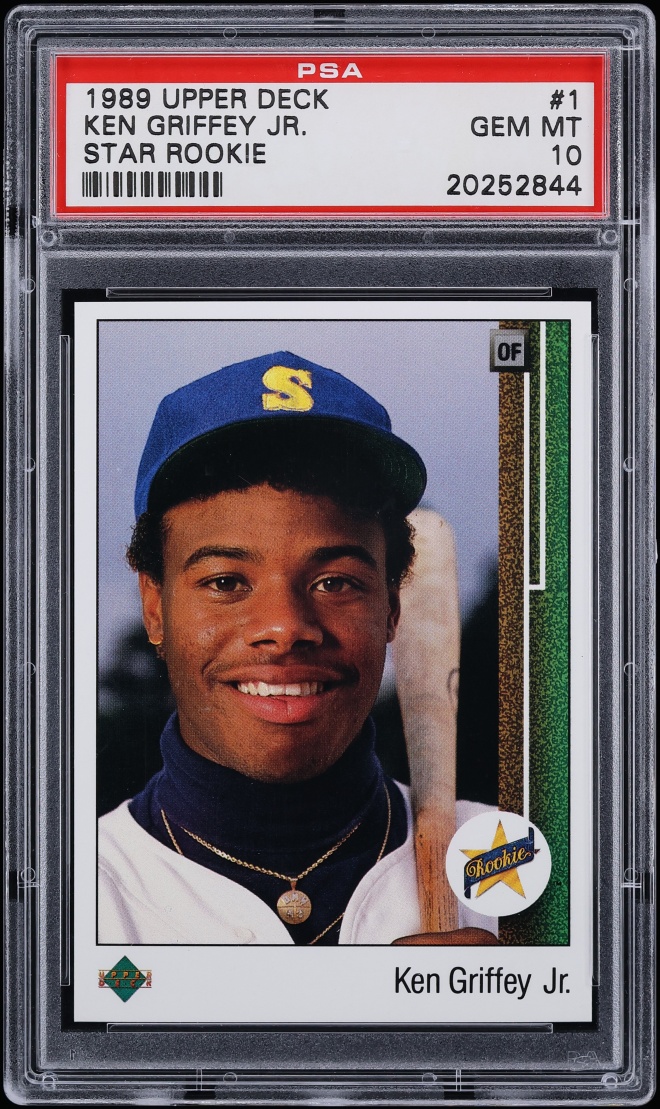
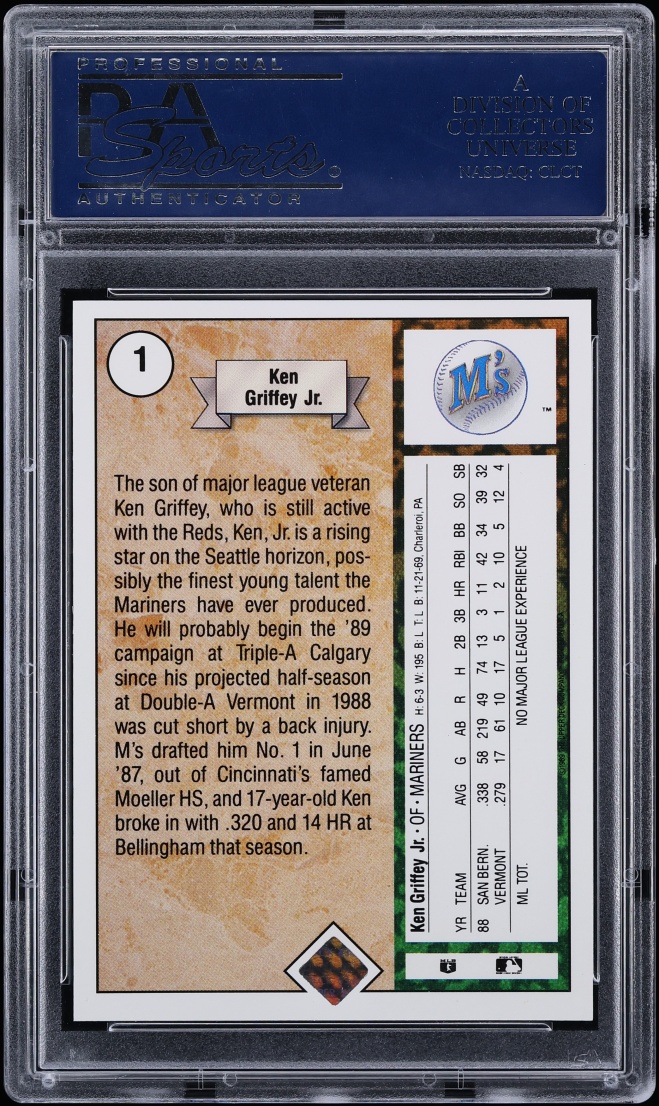
the card
notes
Upper Deck put Ken Griffey Jr. on card number 1 before he had played a major league game.
Topps had spent decades reserving number 1 and the round hundreds for established stars. Upper Deck gave the slot to a nineteen-year-old who had never taken a major league at-bat, on the recommendation of Tom Geideman, an employee who was himself a teenager at the time. The decision was made in late 1988. Griffey debuted the following April.
He turned out to be worth it. Thirteen All-Star selections, ten Gold Gloves, the 1997 American League MVP, 630 home runs, and election to the Hall of Fame in 2016 on 99.32 per cent of the ballot, the highest share anyone had ever received. In 1990 and 1991 he played alongside his father in Seattle, and on 14 September 1990 the two of them hit back-to-back home runs, which had never happened before and has not happened since.
None of which makes the card scarce. It is the opposite of scarce.
PSA has graded 129,787 copies of card 1. To put that number somewhere useful: PSA has graded 237,044 cards from the entire 800-card set, and the Griffey is 54.8 per cent of them. More than half of every 1989 Upper Deck card ever submitted to PSA is this one card. The other 799 share the rest.
There are 4,249 in PSA 10. Nearly two thirds of the graded population - 65.7 per cent - comes back PSA 8 or better, and PSA 8 alone accounts for 47,193 copies.
So this is a card where condition sorts you into a very crowded room rather than an empty one. Which is what makes what has happened to its price interesting.
Three ordinary PSA 10s sold at auction for $5,280 in March 2021, $5,368 in April 2026 and $5,124 in May 2026. Five years, no movement.
Then in August 2026 one sold for $12,810. Same grade. Same card. The difference was a sticker.
The card carried an MBA Gold Diamond - a certification from Mike Baker Authenticated, a company founded in 2020 that examines cards already graded by PSA, SGC or BGS and rates them against others at the same grade. Silver means superior eye appeal, roughly the top fifteen per cent for the grade. Gold means MBA judged the card worthy of at least half a grade higher than it received. Black is reserved for the top fraction of a per cent.
The April 2026 sale at $5,368 carried an MBA Silver. It brought about five per cent more than the unstickered card six weeks later. The Gold brought two and a half times as much.
That is the whole argument about eye appeal grading, playing out on one card in four sales. A PSA 10 is not a single condition, it is a range, and on a card with 4,249 of them the market has started paying for a second opinion about where inside that range a particular copy sits. Whether that second opinion is worth what people are paying for it is contested - there are collectors who regard the entire sticker business as a fee attached to something a buyer could assess by looking. The sales are not contested. Both things are true at once.
population
PSA
| grade | graded | share | at this grade or better |
|---|---|---|---|
| PSA 10 | 4,249 | 3.3% | 3.3% |
| PSA 9 | 33,793 | 26.0% | 29.3% |
| PSA 8 | 47,193 | 36.4% | 65.7% |
| PSA 7 | 16,512 | 12.7% | 78.4% |
| PSA 6 | 14,950 | 11.5% | 89.9% |
| PSA 5 | 8,010 | 6.2% | 96.1% |
| PSA 4 | 3,057 | 2.4% | 98.4% |
| PSA 3 | 1,013 | 0.78% | 99.2% |
| PSA 2 | 398 | 0.31% | 99.5% |
| PSA 1 | 404 | 0.31% | 99.8% |
| PSA AUTH | 208 | 0.16% | — |
| total graded | 129,787 | 100% |
graded elsewhere
recorded 29 aug 2026. figures are a snapshot on that date, not a live count.
recorded sales
| 23 aug 2026 | PSA 10 | Heritage auction | $12,810 |
| auction 50087, lot 80342; MBA Gold Diamond | |||
| 17 may 2026 | PSA 10 | Heritage auction | $5,124 |
| auction 50085, lot 80649; no eye-appeal sticker | |||
| 25 apr 2026 | PSA 10 | Heritage auction | $5,368 |
| auction 70026, lot 58367; MBA Silver Diamond | |||
| 18 mar 2021 | PSA 10 | Heritage auction | $5,280 |
| auction 60003, lot 59104 | |||
dated past results, not an estimate of what a copy is worth today. figures published by an auction house normally include the buyer's premium, so they are more than the seller received.
where to buy one
Almost every copy of this card is worth very little, and that is not a criticism. It was printed in enormous numbers at the peak of the overproduction era and 129,787 have been graded.
The practical grades are 8 and 9. Between them they account for 80,986 copies, they are cheap, and they are the same photograph as the expensive ones. If you want the card, buy one of those.
PSA 10 is where the money starts and it has been remarkably flat - three auction results between $5,124 and $5,368 across five years. That is a liquid, well-established price on a card with 4,249 gem copies, which is the opposite of a squeeze.
What is moving is eye-appeal certification. An MBA Gold Diamond copy sold for $12,810 in August 2026. If you are buying at PSA 10 you now need to decide whether you are buying the grade or the sticker, because they are different prices for the same number on the label.
Two condition problems specific to this set, and both matter more than the grade suggests. The photo surface is slick and scratches from ordinary shuffling, which is why so many raw copies fail. And the hologram on the reverse can lift or tear. Cards with missing or duplicated holograms are common, are defects rather than variations, and trade at a discount.
Buy graded above PSA 8. Surface scratches do not photograph well and you will not see them in a listing.
find one on ebaywhat to check before you buy
Look at the surface first, not the corners. This card scratches. The stock is slick and a card shuffled a few times in 1989 carries marks that only show under angled light. It is the main reason copies that look clean come back a 7 or an 8.
Check the hologram on the back. It should be present, single, and intact. Missing holograms, duplicated holograms and lifting or torn holograms all occur and all reduce the card to a discounted defect rather than a variation.
Check centering on both sides.
Read the label for a qualifier. 852 graded copies carry one.
And read the label for a sticker. An MBA Gold Diamond on a PSA 10 has traded at more than double a plain PSA 10 of the same card, so the presence or absence of one is a price-relevant fact you should notice before bidding rather than after.
sources
| PSA Population Report, 1989 Upper Deck | 2026-08-27 |
| Beckett - 1989 Upper Deck error corrections and print-run percentages | 2026-08-27 |
| Cardboard Connection - 1989 Upper Deck set history, packs and subsets | 2026-08-27 |
| Mike Baker Authenticated - diamond designation criteria | 2026-08-27 |
| PSA Population Report | 2026-08-27 |
| Beckett Grading Services population report | 2026-08-29 |
| SGC population report | 2026-08-29 |
| CGC census | 2026-08-29 |