CARDBOARDFILE
basketball / 1986-87 Fleer / 67
1986-87 Fleer Jeff Malone #67
The scarcest gem in the set, and not because it is the hardest card to grade.
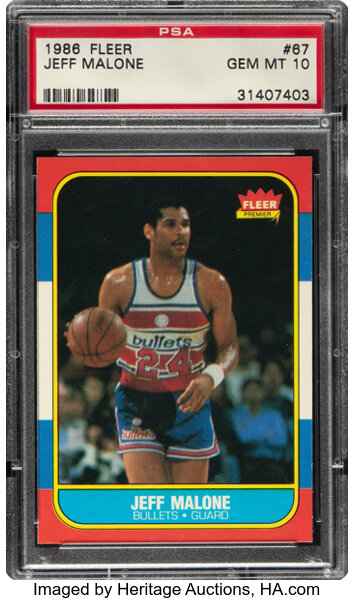
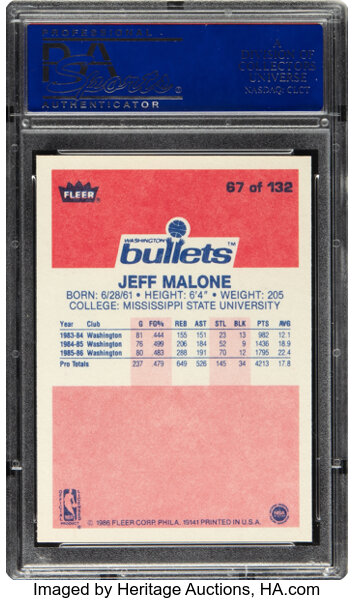
the card
notes
Sixty-seven copies of card 67 have graded PSA 10. That is the fewest of any card in the 1986-87 Fleer set - fewer than the Jordan at 335, fewer than Johnny Moore at 69, fewer than the checklist at 89.
Jeff Malone was a good player. Two All-Star selections, a career average of about 19 points a game built on one of the better mid-range jumpers of the era, seven seasons with the Washington Bullets and then a move to Utah, where he played alongside Karl Malone and John Stockton on the team that reached the Western Conference Finals in 1992. He is not in the Hall of Fame and nobody collects him.
That last fact is the reason this card is scarce, and it is worth being precise about why, because the usual explanation is wrong.
The Malone is not the hardest card in this set to grade. It gems at 1.98 per cent. The Jordan gems at 1.19 per cent, the Dominique Wilkins at 1.20, the Larry Bird at 1.50. All three are harder. If you sent a hundred raw copies of each to PSA, you would get more perfect Malones back than perfect Jordans.
What makes the Malone scarce is that only 3,377 copies have ever been submitted, against 28,151 Jordans. Nobody pays fifteen dollars to grade a Jeff Malone common on the chance it comes back a 10. So the population report for this card is not a record of how many survived in good condition. It is a record of how few people bothered to find out.
Which leaves a card that a set builder cannot avoid. The PSA Set Registry wants all 132, and 131 of them are obtainable. This one is the wall. That is the whole market: a two-time All-Star nobody thinks about, whose card in perfect condition costs more than most of the Hall of Famers printed beside him.
The rest of the ladder looks like an ordinary common. Just two PSA 2s and three PSA 3s exist, because a beaten Jeff Malone is worth nothing and never gets sent in. Almost the entire graded population sits at 8 and 9 - 1,559 and 804 copies - which is what happens when the only cards submitted are the ones somebody already thought looked clean.
population
PSA
| grade | graded | share | at this grade or better |
|---|---|---|---|
| PSA 10 | 67 | 2.0% | 2.0% |
| PSA 9 | 804 | 23.8% | 25.8% |
| PSA 8 | 1,559 | 46.2% | 72.0% |
| PSA 7 | 574 | 17.0% | 89.0% |
| PSA 6 | 257 | 7.6% | 96.6% |
| PSA 5 | 78 | 2.3% | 98.9% |
| PSA 4 | 32 | 0.95% | 99.8% |
| PSA 3 | 3 | 0.09% | 99.9% |
| PSA 2 | 2 | 0.06% | 100.0% |
| PSA 1 | 0 | 0% | 100.0% |
| PSA AUTH | 1 | 0.03% | — |
| total graded | 3,377 | 100% |
graded elsewhere
recorded 29 aug 2026. figures are a snapshot on that date, not a live count.
recorded sales
| 17 may 2026 | PSA 10 | Heritage auction | $56,120 |
| auction 50085, lot 80949; cert 31407403 | |||
| 23 mar 2024 | PSA 10 | Heritage auction | $26,400 |
| auction 70011, lot 58145; cert 25316937 | |||
dated past results, not an estimate of what a copy is worth today. figures published by an auction house normally include the buyer's premium, so they are more than the seller received.
where to buy one
Below PSA 9 this is a common and priced like one. That is not what anyone is buying it for.
At PSA 10 you are competing with registry set builders who need this specific card and have no alternative to it, and PSA has recorded 67 of them. Heritage sold one for $26,400 in March 2024 and another for $56,120 in May 2026 - a different copy, and more than double the price twenty-six months later. The recorded population barely moved in between.
PSA 9, with 804 recorded copies, is the sensible target for anyone who wants the card rather than the registry slot, and it is a fraction of the price.
If you are buying raw with the intention of grading, understand the odds honestly. The card gems at about one in fifty. That is better than the Jordan in the same set, but it is still fifty submissions to expect one 10.
No counterfeits of this card are documented, and the fakes in this set concentrate on card 57 and card 7. That is a reason to worry less here, not a reason to skip checking the certificate on an expensive copy.
find one on ebaywhat to check before you buy
Centering first. It is the usual reason this card misses, and on a red-bordered 1986 Fleer any drift is visible on all four sides at once.
Check the red border for chipping. Colour runs to the edge, so a nick has nowhere to hide.
Look for print snow and surface specks under angled light. They are common across this set and they are what separates a 9 from a 10 on a card that is otherwise clean.
Read the label for a qualifier. 52 graded copies carry one.
And if you are buying at PSA 10, verify the certificate number with PSA directly. At this price the card is worth faking even if the player is not.
sources
| PSA Population Report, 1986 Fleer | 2026-08-27 |
| Old Sports Cards - gem rates for the scarcest 1986 Fleer commons | 2026-08-27 |
| Heritage Auctions archive - lot results and certificate numbers | 2026-08-27 |
| GemRate - combined population across PSA, Beckett, SGC and CGC | 2026-08-29 |
| Beckett Grading Services population report | 2026-08-29 |
| SGC population report | 2026-08-29 |
| CGC census | 2026-08-29 |