CARDBOARDFILE
hockey / 1979-80 O-Pee-Chee / 18
1979-80 O-Pee-Chee Wayne Gretzky #18
Gretzky's rookie card, from a season the NHL refused to call a rookie season.
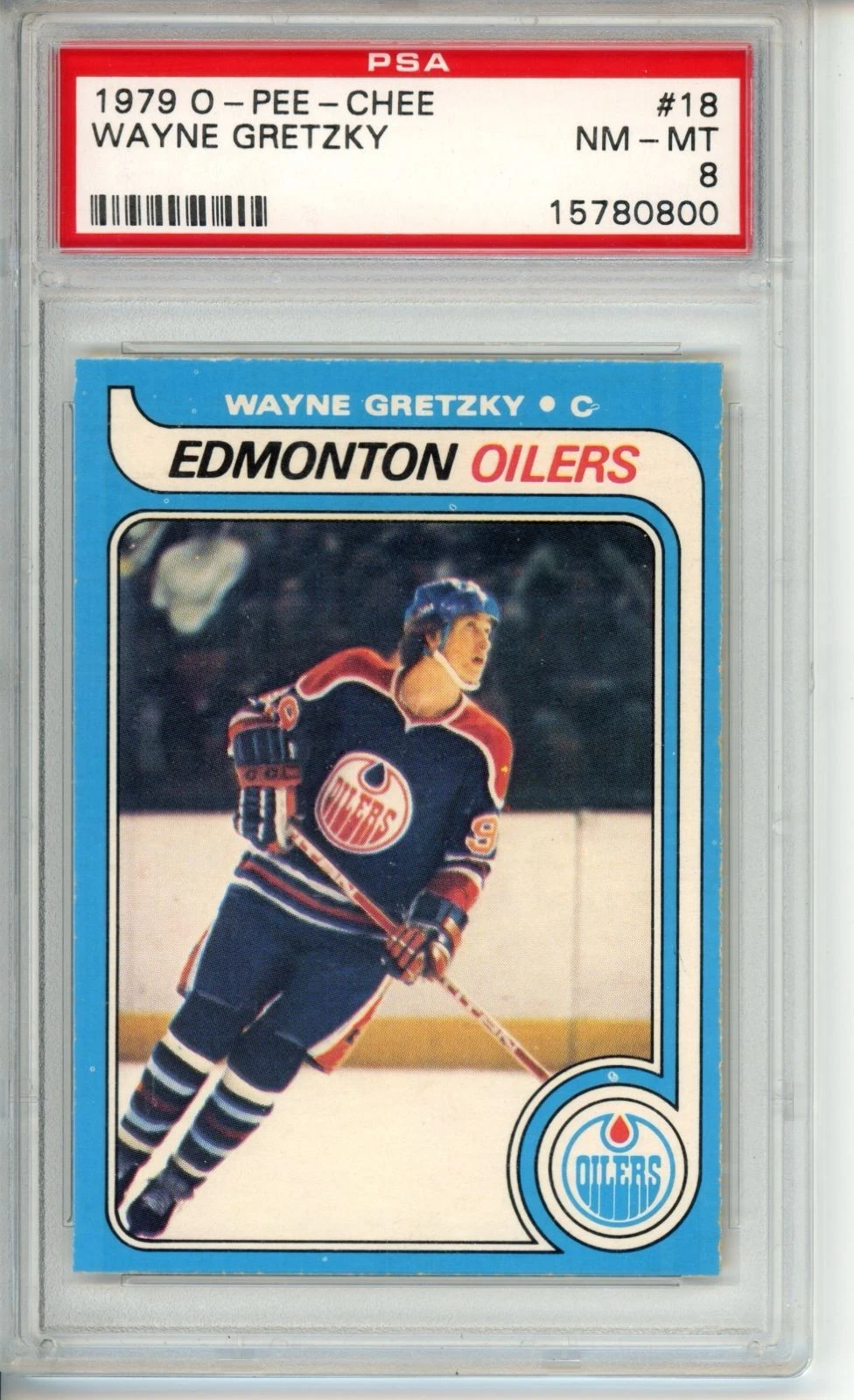
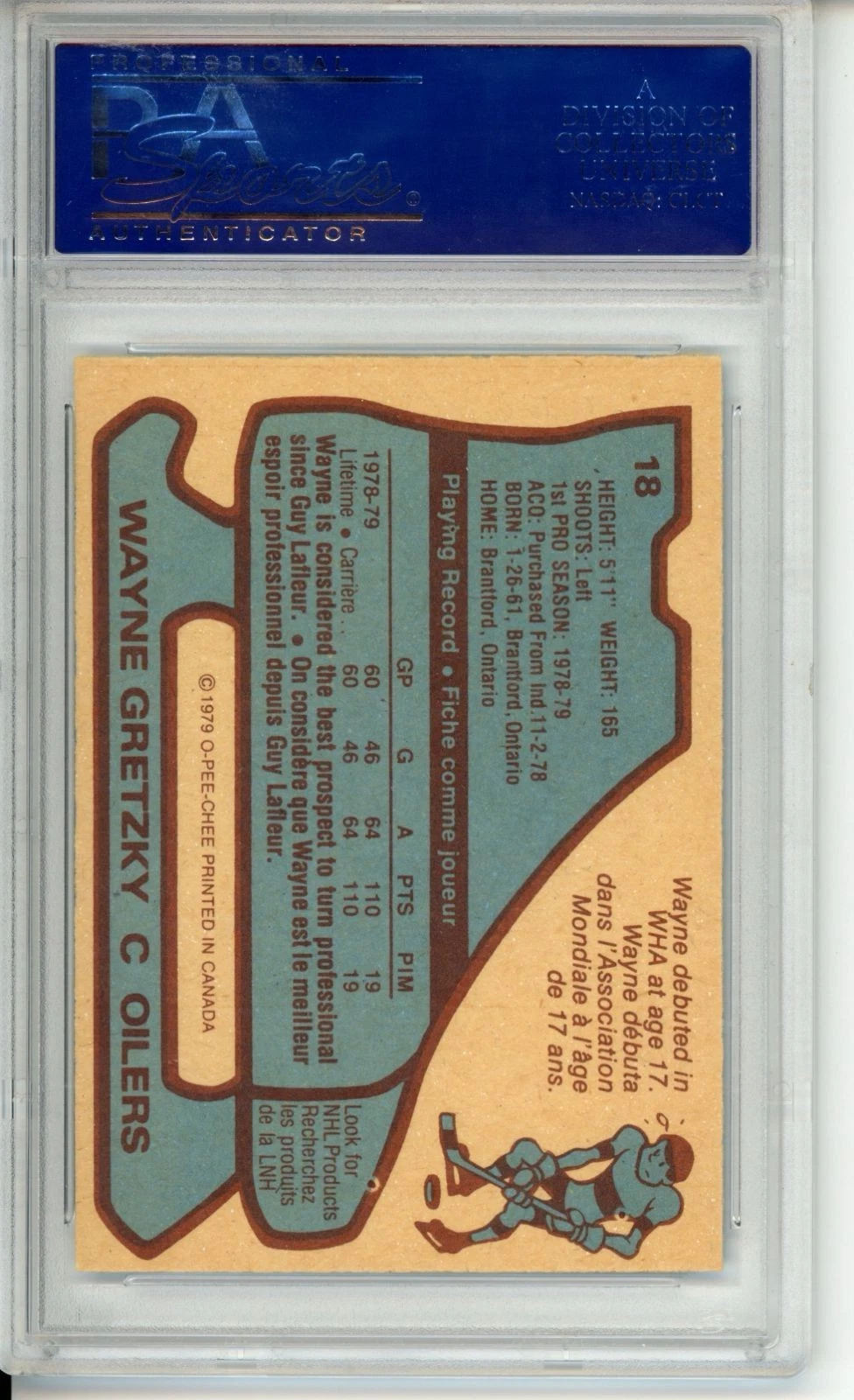
the card
notes
Card 18 in the 396-card O-Pee-Chee set is the most valuable hockey card in the hobby, and the season behind it is stranger than the card's reputation suggests.
Gretzky signed his first professional contract at 17 with the Indianapolis Racers of the World Hockey Association, played eight games, and was sold to the Edmonton Oilers. When the WHA folded, four of its clubs were absorbed into the NHL under an expansion agreement effective June 22, 1979, and Gretzky arrived in the league with the Oilers. He made his NHL debut on October 10, 1979 at Chicago Stadium, a 4-2 loss, and picked up an assist.
He finished with 51 goals and 86 assists in 79 games. His 137 points tied Marcel Dionne for the league lead, and Dionne took the Art Ross on the tiebreaker of two more goals, 53 to 51. Gretzky won the Hart as most valuable player and the Lady Byng, at 19.
What he did not win was the Calder. The rookie award is restricted to players who have not appeared in more than 25 games in a previous season in any major professional league, and the WHA counted. So the best first NHL season anyone has ever played is not in the record book as a rookie season at all. The official rookie points record stayed where Bryan Trottier left it in 1975-76, at 95, while Gretzky's 137 sat outside the category entirely.
That is the tension this card carries. Everyone calls it a rookie card, and by the NHL's own rules the season it documents was not a rookie season.
The card is also the first NHL card of the Edmonton Oilers, not just the first of Gretzky. Blue border, team logo lower right, bilingual back carrying 1978-79 and career statistics.
It is very hard to find in high grade, and the reason is the printing rather than the handling. Blue borders chip, centering was inconsistent, and O-Pee-Chee's cutting left edges that would be called damage on almost any other card. Copies graded PSA 9 routinely show rough cut edges and light factory discolouration in the red Oilers lettering. Those are production characteristics, not wear.
population
PSA
| grade | graded | share | at this grade or better |
|---|---|---|---|
| PSA 10 | 2 | 0.01% | 0.01% |
| PSA 9 | 95 | 0.70% | 0.71% |
| PSA 8 | 856 | 6.3% | 7.0% |
| PSA 7 | 1,482 | 10.9% | 17.9% |
| PSA 6 | 2,100 | 15.5% | 33.4% |
| PSA 5 | 2,052 | 15.1% | 48.5% |
| PSA 4 | 2,575 | 19.0% | 67.4% |
| PSA 3 | 1,864 | 13.7% | 81.2% |
| PSA 2 | 1,328 | 9.8% | 90.9% |
| PSA 1 | 1,056 | 7.8% | 98.7% |
| total graded | 13,584 | 100% |
graded elsewhere
recorded 29 aug 2026. figures are a snapshot on that date, not a live count.
recorded sales
| mar 2021 | PSA 10 | Heritage | $3,750,000 |
| dec 2020 | PSA 10 | Heritage | $1,290,000 |
| Same card as 2011 and 2016 sales | |||
| 2016 | PSA 10 | - | $465,000 |
| 2011 | PSA 10 | Heritage | $94,000 |
dated past results, not an estimate of what a copy is worth today. figures published by an auction house normally include the buyer's premium, so they are more than the seller received.
where to buy one
Graded, and from a seller who shows both sides.
This is one of the most counterfeited cards in the hobby. It was illegally reprinted, and while most of those reprints were found and either destroyed or marked as reprints, unmarked ones survive and they are hard to tell from the real card by eye. A holder from PSA, SGC or BGS removes the question, and at this card's price there is no good argument for buying it raw.
Grade decides everything else. PSA 4 is the most common grade this card comes back in, and the mid range from 3 to 6 is where most copies actually change hands. PSA 7 and 8 are a different market again, and 9 is rare enough that individual copies get tracked by name.
If the O-Pee-Chee is out of reach, the 1979-80 Topps #18 is the same photograph in a smaller American set and sells for a fraction of the Canadian version at every grade. It is a legitimate card of the same season, not a substitute and not a reprint.
find one on ebaywhat to check before you buy
Check the back first. An O-Pee-Chee card is bilingual, English and French, and the copyright line reads Printed in Canada. The Topps version of the same player at the same number is English only and printed in the USA. They look nearly identical from the front, and sellers confuse them constantly in both directions.
Do not read rough edges as damage. O-Pee-Chee cut its sheets with wires rather than blades, and stacked the sheets to do it, so slightly furred edges are original to the card rather than evidence of handling. Copies with them have graded as high as PSA 9. The same goes for light discolouration in the red Oilers lettering, which is a factory characteristic.
That cutting method inverts into a useful test. A 1979-80 O-Pee-Chee with genuinely clean, sharp edges was cut by something that was not a wire, which means it was not cut in 1979. Sharpness is a warning here, not a virtue.
There is also a small yellow print dot on Gretzky's left shoulder, left by a spot the yellow negative was not opaqued over. It appears on genuine copies and is widely used as a check. Treat it as one signal among several rather than proof - a forger reproducing the card reproduces the dot with it.
Do read the blue borders carefully. Chipping shows as white specks along the edge, and it is the most common reason this card grades lower than a buyer expects.
Centering is chronic across the whole set. Check both sides, because the back is often worse than the front.
On a raw card, be suspicious of anything that looks too good. A 1979 O-Pee-Chee with sharp edges, clean borders and square centering is a card that should already be graded, and the fact that it is being sold raw is worth asking about.
sources
| All Vintage Cards - spotting a fake Gretzky rookie: wire-cut edges and the yellow print dot | 2026-08-29 |
| Sports Illustrated - O-Pee-Chee against Topps on the Gretzky rookie | 2026-08-29 |
| Sports Collectors Daily - Beyond Gretzky: wire cutting, blue-border chipping and centring in the 1979-80 O-Pee-Chee set | 2026-08-29 |
| Beckett - 1979-80 O-Pee-Chee: pack contents, bilingual backs, and the five numbers that differ from Topps | 2026-08-29 |
| PSA Population Report, 1979 O-Pee-Chee | 2026-08-27 |
| GemRate - combined population across PSA, Beckett, SGC and CGC | 2026-08-29 |
| Beckett Grading Services population report | 2026-08-29 |
| SGC population report | 2026-08-29 |
| CGC census | 2026-08-29 |